


Simple leadership frameworks are seductive—especially under pressure. A clean matrix. Four boxes. Clear instructions for who deserves your energy. And just like that, leadership feels manageable again.
That’s the promise. It’s also the problem. Most leadership frameworks don’t fail in theory; they fail in the exact moment leaders rely on them most.
The Comfort of Categorization
Frameworks that sort people by “skill” and “will” give leaders something invaluable when things feel messy: relief. Relief from ambiguity, from responsibility, and from asking harder questions. Once people are categorized, the story becomes simple:
- High performers get autonomy.
- High potentials get coaching.
- Disengaged experts need listening.
- Low performers need quick decisions.
It is efficient, logical, and reassuring. It is also a substitute for courage, because categorization often replaces confrontation.
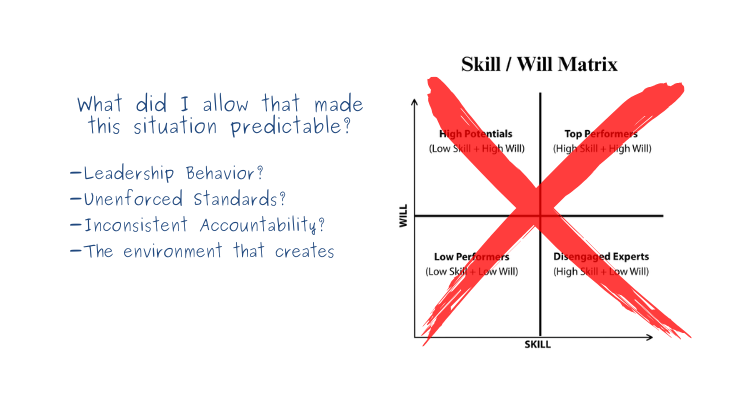
The Missing Axis: The Leader
The most striking thing about a Skill/Will matrix, for example, is what it omits. There is no axis for:
- Leadership behavior
- Standards enforced
- Accountability applied
- The environment those choices create
The leader stands outside the system, categorizing others as if skill and will emerge in a vacuum. That’s spectatorship, not leadership. Any model that allows leaders to evaluate people without simultaneously evaluating themselves is incomplete by design.
“Will” Is an Output, Not an Input
Most frameworks treat “will” (motivation and engagement) as a resource people bring with them—like fuel in a tank. But in a professional environment, will is a lagging indicator.
Will rises when expectations are explicit, standards are protected, and integrity is visible. Will erodes when leaders avoid conflict, send mixed signals, or tolerate poor behavior from “high performers.”
By the time someone is labeled “disengaged” or “low will,” leadership drift has already occurred. This matrix treats “will” as a personal defect to be diagnosed; in reality, it is usually a signal of leadership quality.
Where Failure Gets Buried
The flaws of the matrix are most visible in the “Disengaged Expert” and “Low Performer” quadrants:
- The Disengaged Expert: The matrix suggests finding the “root cause” or resetting expectations. This assumes the disengagement is a mystery rather than a product of broken psychological contracts or watching standards being compromised. Resetting expectations here is often too late because leadership credibility has already been spent.
- The Low Performer: The bottom-left box looks decisive: make a fast decision. But by the time someone reaches this box, leadership has almost always failed upstream. Standards were unclear, feedback was diluted, and performance drift was normalized.
Fast decisions at the end do not compensate for slow leadership earlier. This matrix treats removal as a strength. In reality, strength would have shown up much sooner.
The Leadership Move That Gets Skipped
Effective leadership does not begin by classifying people; it begins by declaring and defending a non-negotiable standard. Before sorting people into boxes, leaders owe them one thing: a standard that defines what contribution looks like, what behaviors are required, and what will no longer be tolerated. When standards are real, people don’t need to be sorted. They self-correct, they self-commit, or they self-select out.
Sorting is what leaders do when standards are fuzzy and pressure is high.
The Real Question
The popularity of these models persists because they provide language without demanding change. They feel strong without requiring courage. But the most important question for any struggling leader is rarely found on a matrix:
“What did I allow that made this situation predictable?”
Until leaders confront that honestly, no framework will save them. It will only make leadership failure more organized. Under pressure, incompleteness is not neutral—it’s destructive.